Back to projects
Research Projects
01 High-redshift black holes and AGNs 02 Active High-redshift galaxies and star formation 03 Artificial Intelligence for astronomy

Project 02 / Cosmic dawn simulations

High-redshift Galaxies and Star Formation

This project studies star formation in early galaxies across interstellar, circumgalactic, and cosmological scales.

Video credit: THESAN-ZOOM Simulations.

Research directions

Galaxy formation and cosmic star formation

Project route 1 / THESAN-ZOOM projects

High-redshift galaxy formation.

This project studies dense gas, giant molecular clouds, feedback, and wavelength-dependent morphology in early galaxies.

View work

Project route 2

Cosmic star formation.

This project studies how stellar populations and the initial mass function respond to radiative environments, with implications for compact high-redshift sources such as Little Red Dots.

View direction

THESAN-ZOOM projects

Galaxy formation at the Epoch of Reionization.

Cover image for star formation efficiency in THESAN-ZOOM

Published / galaxy and cloud scales

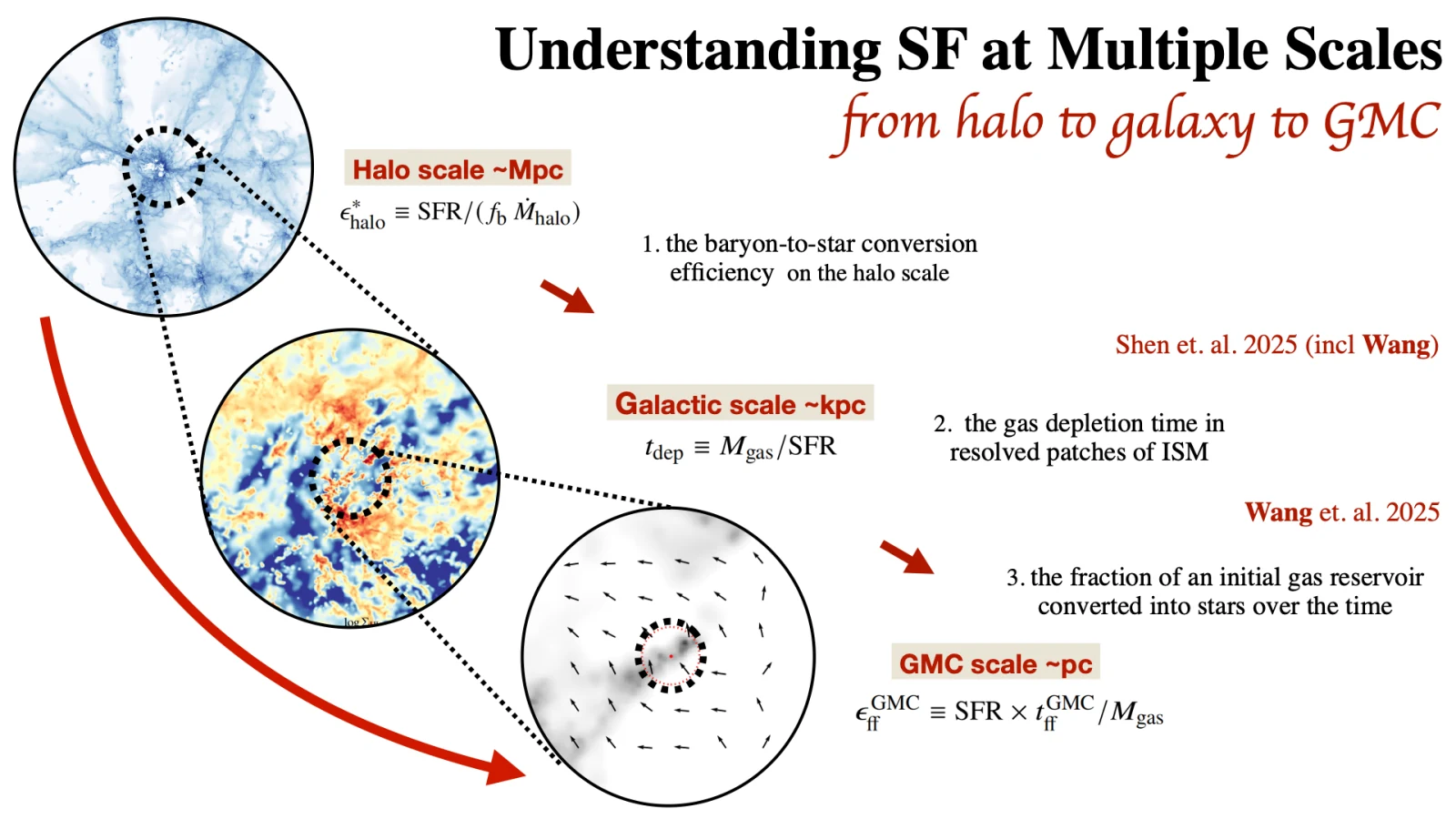
Multi-scale investigation of star formation efficiency at high redshift

Author list: Zihao Wang, Xuejian Shen, Mark Vogelsberger, Hui Li, Rahul Kannan, Ewald Puchwein, Aaron Smith, Josh Borrow, Enrico Garaldi, Laura Keating, Oliver Zier, William McClymont, Sandro Tacchella, Yang Ni, Lars Hernquist

The work connects global galaxy-scale star formation efficiency to local cloud-scale physics, asking which scales are responsible for apparently elevated baryon conversion efficiency at high redshift.
  • Star formation is predominantly hosted by filamentary giant molecular clouds embedded in dense, high-pressure interstellar media.
  • At the GMC scale, star formation appears nearly universal across redshift and halo mass.
  • GMC gas surface density remains nearly constant, while dark matter surface density rises toward high redshift.
  • At z > 10, dark-matter-dominated GMCs can emerge and may exhibit elevated star formation efficiencies.
  • The GMC mass fraction is the dominant factor shaping the global SFR-surface density relation.
Read the paper
Cover image for galaxy clumpiness across wavelengths

Preprint / morphology and feedback

Clumpiness across wavelengths, redshifts, and galaxy formation models

Author list: Zihao Wang, Xuejian Shen, Rahul Kannan, Ewald Puchwein, Aaron Smith, Josh Borrow, Enrico Garaldi, Laura Keating, Mark Vogelsberger, Oliver Zier, William McClymont, Sandro Tacchella, Fangzhou Jiang, Hui Li, Lars Hernquist

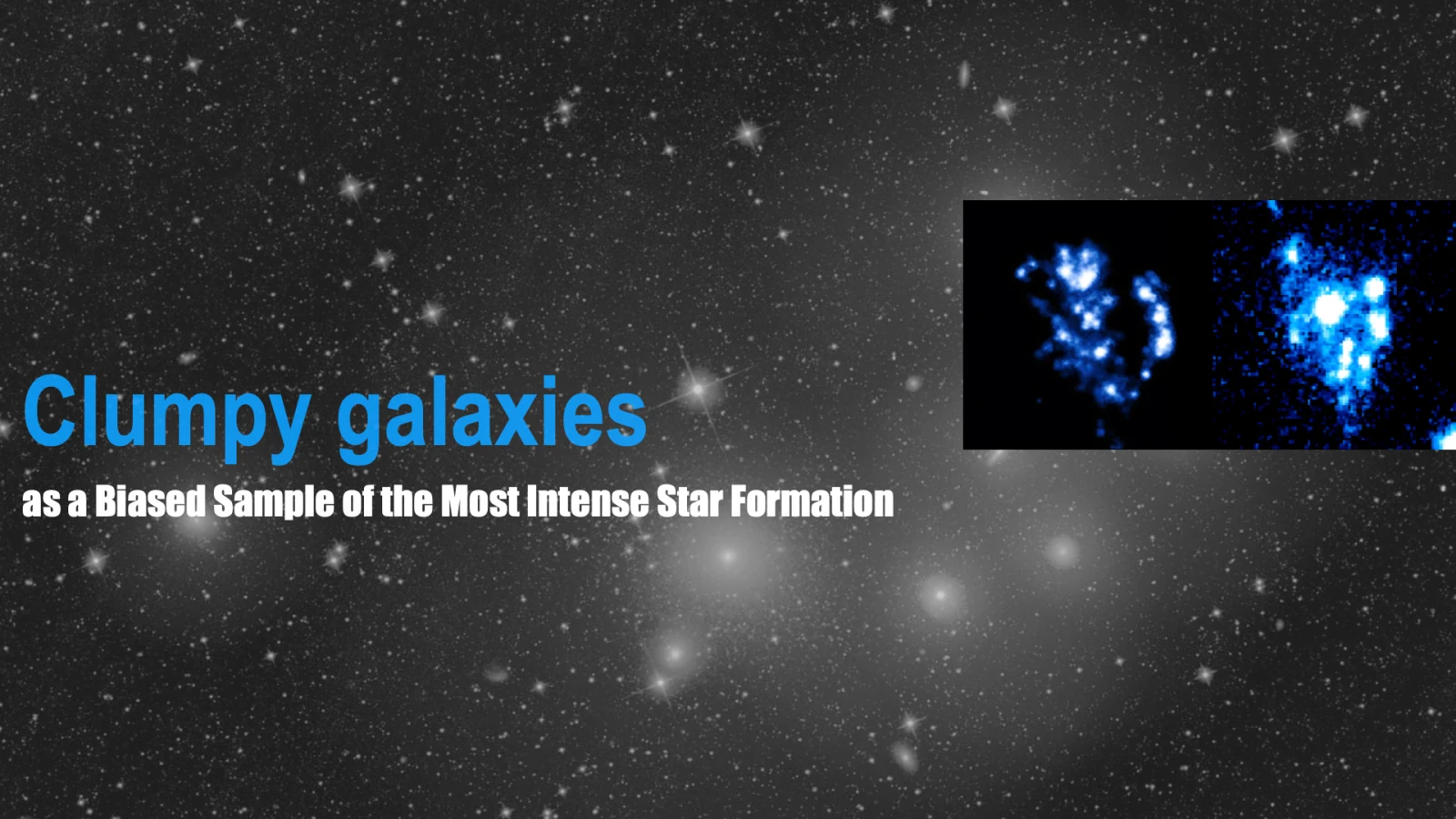
Recent JWST observations reveal irregular and clumpy high-redshift galaxies. This work uses a power-spectrum-based approach to quantify clumpiness across spatial scales in simulations.

  • Intrinsic stellar mass distributions remain comparatively smooth over cosmic time.
  • Emission fields such as H alpha, FUV, and optical light show systematically stronger small-scale structure.
  • Shorter-timescale star-formation tracers show shallower power spectra and enhanced spatial intermittency on roughly 100-1000 pc scales.
  • Clumpiness is sensitive to stellar feedback prescriptions and varies strongly across bursty star-formation phases.
  • The contrast between clumpy light and smooth stellar mass helps separate intrinsic galaxy structure from observational timescale bias.
Read the preprint

Cosmic star formation

Stellar populations and radiative environments at high redshift.

Developing direction

Radiation, stellar populations, and compact high-redshift sources.

This project models how the initial mass function may respond to radiative environments, and how that response might help explain the evolution of compact sources such as Little Red Dots. It connects the star-formation side of high-redshift galaxies with the black-hole and AGN questions in Project 01.