Project 1
Little Red Dots
This project studies LRD formation and evolution, from halo-scale initial conditions to nuclear black-hole envelopes.
View projectProject 01 / High-redshift AGN
This project studies the origin and evolution of Little Red Dots. It also investigates AGN accretion histories using radiation-hydrodynamics simulations.
The LRD project is developed with Prof. Kohei Inayoshi and Prof. Fangzhou Jiang. The simulation project is being developed with Xuejian Shen.
Projects
Project 1
This project studies LRD formation and evolution, from halo-scale initial conditions to nuclear black-hole envelopes.
View projectProject 2
This project connects simulated SMBH accretion histories to hydrogen and helium proximity zones and the evolving intergalactic medium.
View projectProject 1 / Little Red Dots
JWST has revealed compact sources with blue UV emission, red optical continua, broad emission lines in some cases, and inferred black-hole-to-stellar mass ratios that exceed both local scaling relations and current simulation predictions. Their abrupt emergence and disappearance over z ~ 5-8 make their origin and evolution especially puzzling.

Initial condition for LRD
Assembly bias provides a way to test whether competing LRD formation scenarios occupy distinct halo environments.
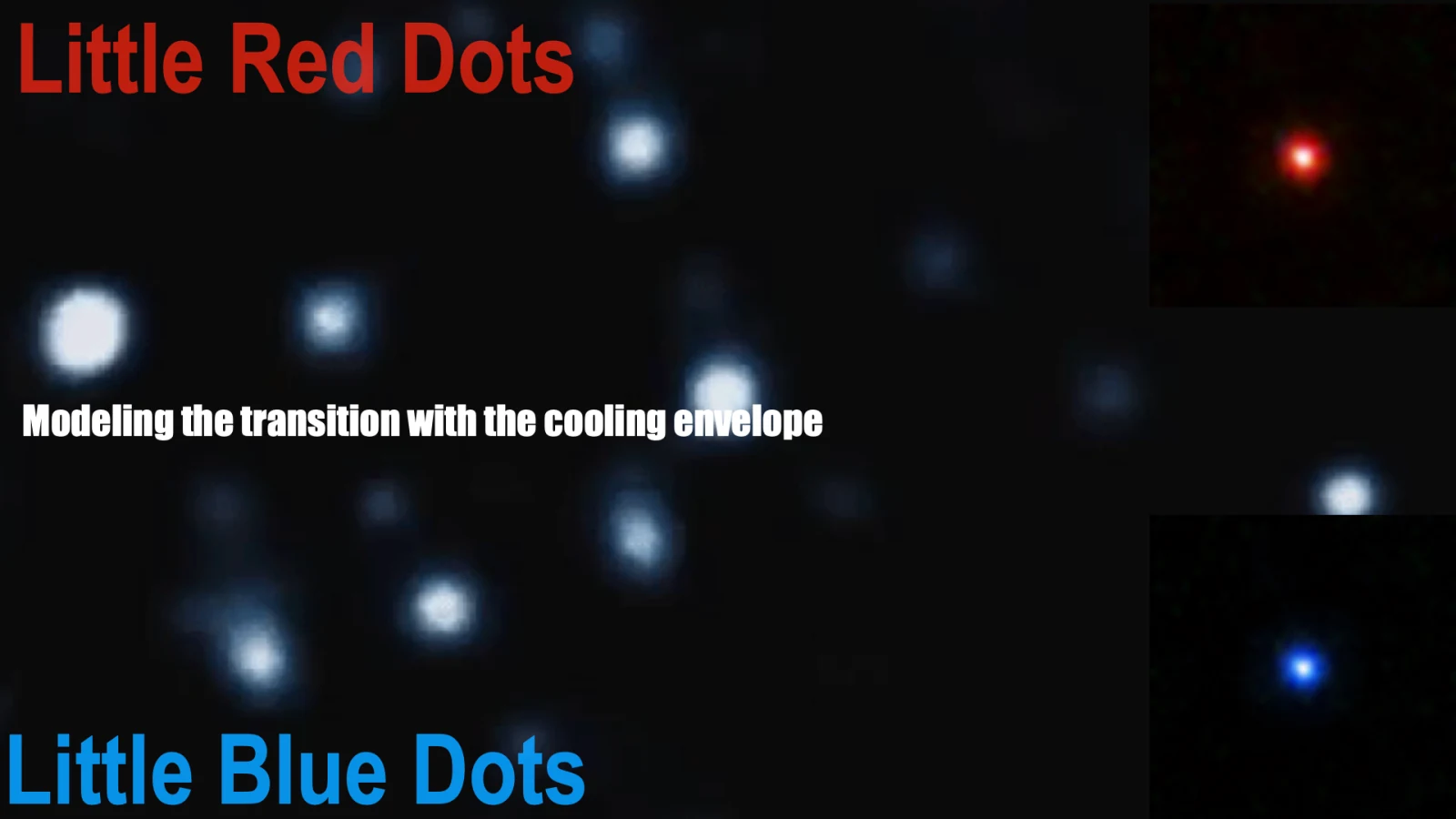
Nuclear transition of LRD
This project studies how Kelvin-Helmholtz contraction of a black-hole envelope connects Little Red Dots to Little Blue Dots as the accretion disk is gradually exposed.
Project 2 / Tracking AGN accretion history in radiation-hydrodynamics simulations
This project uses realistic cosmological simulations to connect AGN variability and lifetime to hydrogen and helium proximity-zone observables during and after the Epoch of Reionization.
Proximity zones
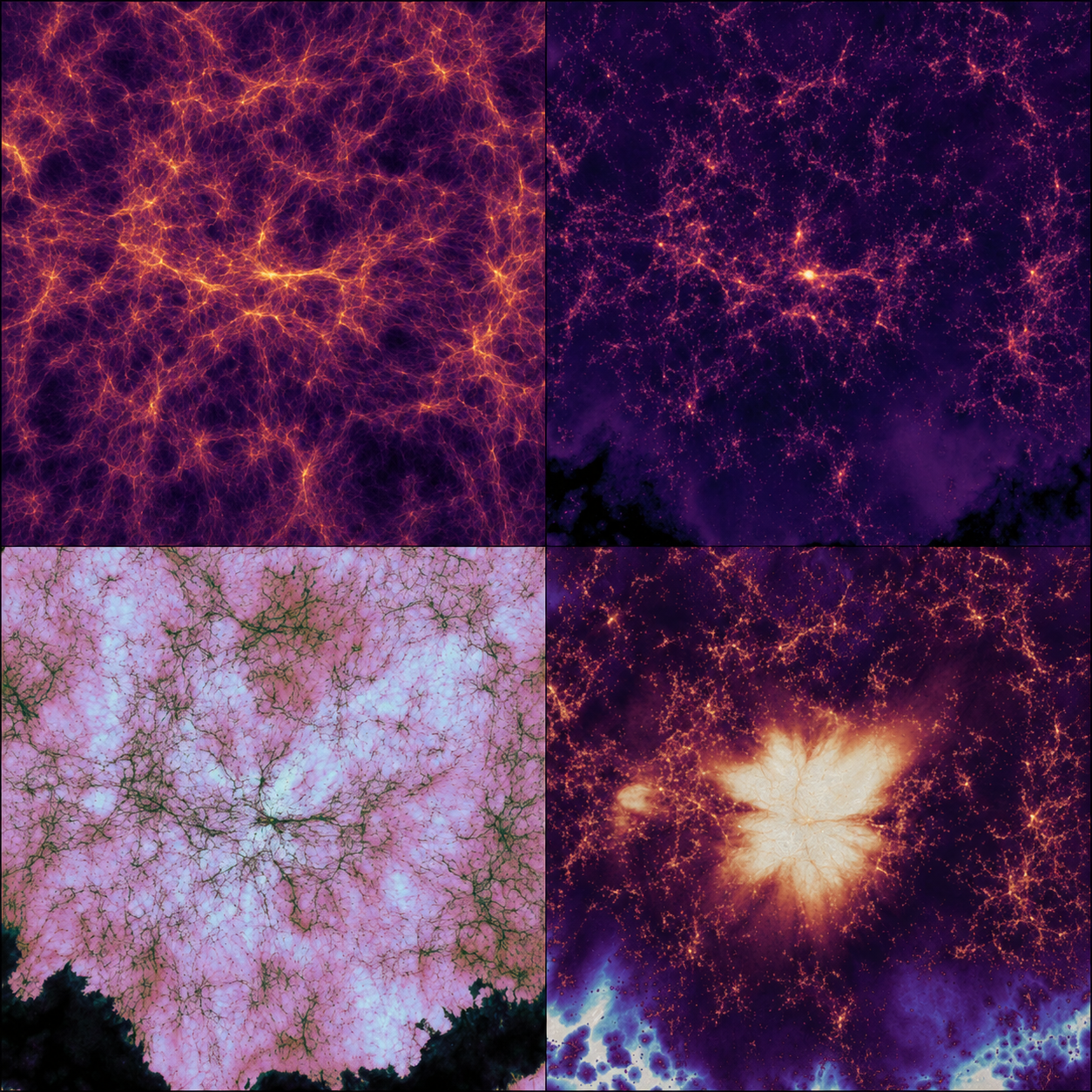
AGN proximity zones probe both the ionization state of the intergalactic medium and the recent growth history of SMBHs, but their interpretation is shaped by AGN variability, finite lifetime, neighboring sources, and line-of-sight density fluctuations.